
From Divorce and Debt to a Multimillion Business: Mike Jacques' Story
5 min read
For thirty years, Mike Jacques lived what most people would call the dream. Enterprise software sales. Business-class flights. Six-figure commissions. Three or four hundred thousand pounds in a good year, more than most doctors and surgeons ever see.
From the outside, it looked like success. Behind the scenes, everything was falling apart.
He didn't have a university degree, and he wouldn't even discover until later in life that he was dyslexic. Neither stopped him becoming one of the highest earners in his industry.
"Anyone who peeped behind the curtains would see that I had a failing marriage, because I was travelling all the time," Mike says. "Even though I was earning ridiculous amounts of money, I was still incurring debt. The harder I worked, the poorer I got, the more miserable I became, and the family was falling apart because I was working so hard."
It all came crashing down with a divorce. He lost his wife, his kids, his dogs, and eventually his house.
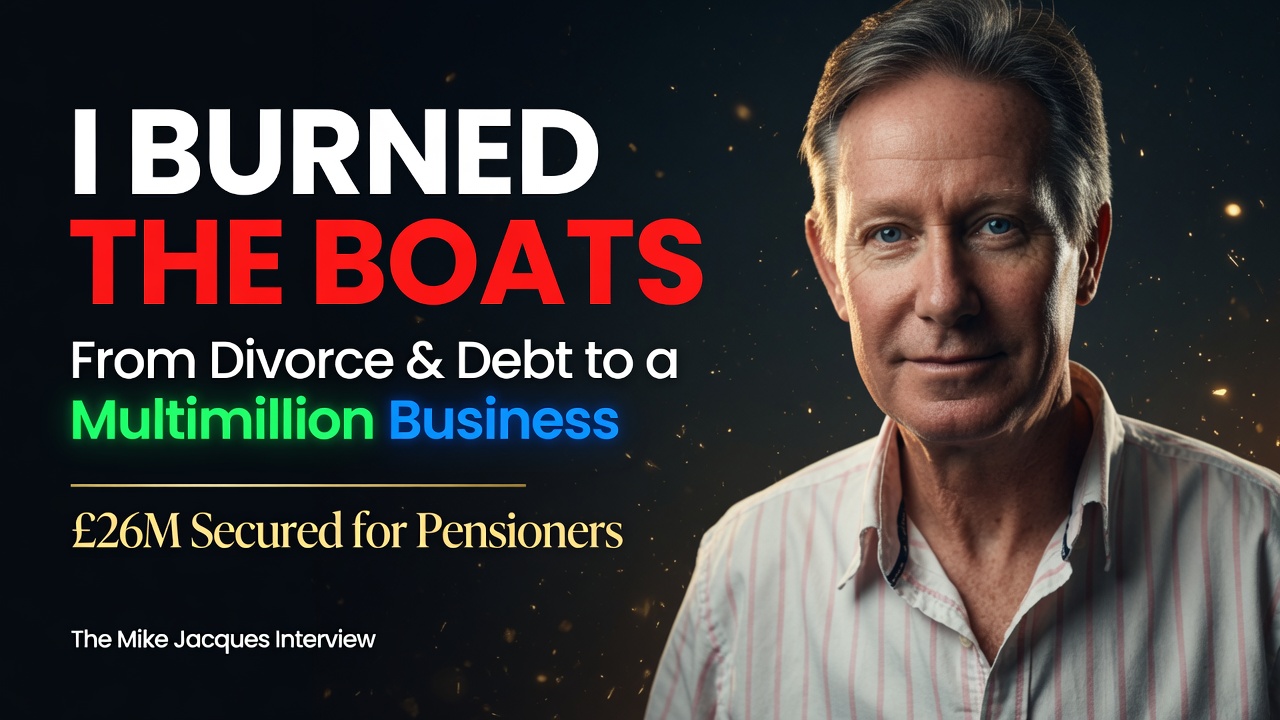
All came obviously crashing down with a divorce, with me losing the wife, the kids, the dogs, and my house eventually. I'm gonna burn the beaches. I'm going for it. It's the best decision I've ever made. Your headline is you have turned one small problem into a multimillion business. Hey, Mike. Good to see you, buddy. It's You too. Yeah. It's been a while. I'm I'm really looking forward to doing this because I'm particularly excited to to share your story because there's a lot of people in today's current job, career, business climate that that need to hear stories like yours. And I'm gonna say it, especially your age group. The sort of, let's say, over fifties? That's not too insulting, is it? No, it's not. No. I'll forget when you first came out to share that you had made your first couple of sales online. And you came out, not your words, not mine, and you said, I just couldn't believe an old fart like me could do this. I did I did say that. Yeah. But, yeah, look look, in all seriousness, we hear from more and more people in the over fifty bracket than ever. And when you actually look at the statistics of people starting businesses, I believe the number one bracket is still mid. But actually the highest success rate in startup entrepreneurial endeavors and the growing number of people starting business is looking very favorable for for people, yeah, thirty five upwards, but certainly the forty five bracket now seems to be really making it happen. And I've seen other statistics now saying that, yeah, that fifties age group is almost the perfect age to start a business. Obviously, lot of life experience, but also being able to build products and services that are relatable in in that market. It's not it's not just about starting like an influencer business in your twenties anymore. But first of all, let's start here because this is what we hear all the time. I've been thinking about doing something of my own for ten years. I'm kicking myself I didn't do something sooner. And that's before they've even started anything. That's before they've even got any real results. Is that a place you ever found yourself, or did you sort of decide now's the time and and do it? I think I was a victim circumstances. I think I I was like most people. You're, you know, you're walking along one day and you have that brilliant idea that you think, that's it. I can make millions, but you don't know how to. You don't have the mechanism. You don't have the experience. You don't have the balls to to actually do it. It's so you don't do anything about it. And then a year later, you see someone else who just made millions on that exact idea that you had walking the dog a year before, and you just think, if only I'd have taken action. And I had a number of I had a number of things, moments like that. And and I just never had the balls to to change. I was stuck in a rut, as they say. And the reason why I was stuck, I had golden handcuffs on. I had a really successful sales career, thirty years in mainly software sales. I was selling to big banks and telcos. I was flying around the world. I had a an enviable expense account that was probably more than most people's salaries. And I was and anyone that looked at me from afar, I was living the dream. The jet set lifestyle, executive, doing really well. Anyone who peep behind the curtains would see that I had a failing marriage because I was traveling all the time. I had even though the I was earning ridiculous amounts of money, I was still incurring debt. My wife at the time could spend faster than I could ever earn. It took me a long time to realize that. And I was slowly sinking into a state of depression because the harder I worked, the poorer I got, the more miserable I became, and the family was falling apart because I was working so hard. And it all came obviously crashing down with a divorce, with me losing the wife, the kids, the dogs, and my house eventually. And at that point, that's when I must have sat down at some point, but that's when I started to get the idea that going and getting another multiple six figure job is not gonna fix my situation. I'm gonna be back here again. It's not the solution. The next job is not the solution. I need to do something different. Did you have much passion, like, at the beginning from the early days? Was it was it a career path that you entered into the software sales that you genuinely like, is the career for me? What was that that side like? I I I mentioned earlier that I my passion was diving, scuba diving, and I was very naive when I was really young and I thought I could go and become a North Sea diver at eighteen years old. So that that was it. I didn't do any research. There was no research towards back then. I don't know was even the Internet back then. But I didn't do any research into what it involved in becoming a North Sea diver. I knew it was great money, and funny enough, I knew it was work hard for two or three weeks, have two or three weeks off. So there was already that idea in my mind that I didn't wanna work nine to five every single week that I wanted time freedom, but it just didn't resonate then. I was too young. But I I got dragged into sales. My next door neighbor worked for Rank Xerox, and he used to listen to me bleed over his TV on the CB radio. He said I had the gift of the gab or something, and he wanted to give me a trial at about eighteen, I think I was. And he got me involved in Xerox. And as soon as I realized it wasn't sitting behind a desk, my my worst nightmare, that it was out on the road and that there was that freedom. You know? I I could go wherever I wanted to. I did have to knock on doors and get rejected and do all the hard stuff, but it was my choice of what town I worked in, where I worked in, how long I worked, as long as I hit my targets. So that was it. I was I was hooked on sales, and I have no regrets. It was a phenomenal ride from from selling photocopiers to moving into printers and IT, then making the leap to software, and then having, you know, earning I wasn't highly educated. I dropped out of school. I found out much later I was dyslexic, which is the reason why I didn't get on with school. But I had a phenomenal ride. You know, I was earning three, four hundred thousand pounds some years selling software. Really good money. And I wasn't highly educated, but I was earning more than doctors and and surgeons and you know? So I was blessed. So it wasn't a career I regretted, but it was something I grew out of, and I realized that there was the dark side. And the dark side to earning that much money was you had a lot of responsibility, you had massive targets to hit, and you were working in a US corporate culture rather than a UK or European culture, which is you work every day of the week, all eight days of the week. And when you go on holiday, you're not on holiday. You're still expected to answer email. You're still expected to answer the phone if there's something serious going on. There was never a break. And even if you felt you had the choice for a break, the sheer amount of money that you might lose by not answering that email, by not talking to someone to go do something to save a deal, that it might fall apart while you're away, the pressure was just enormous. Just the self pressure and the corporation pressure, and it was never ending. And that's what broke the marriage, and that's what broke me eventually. Yeah. Yeah. It's funny because that was I was I was a lot younger. I mean, was in my I was twenty six or something, but I my breaking point literally was when I had my one week holiday booked of the year. And my boss wouldn't leave me alone with messages and emails and can you just can you just double check this thing for me? What's going on with this file? And I'm like, man, this this was my one week. I know you're on holiday, but yeah. Yeah. You know, it's it's it's something that comes up a lot. You know, you hear from we hear in our community so often that people actually quite like the jobs that they get into initially, and as they sort of rise up the ranks and take on more responsibility for quite often, not like you, just a little bit more money. That there starts to become a negotiation as in terms of what level of responsibility and access to me is worth it. You know? And as as you were saying, it starts to impact at home and family, marriages and all the rest of it. It it sort of becomes macho, you know? You're you're in a you're in a group of people that are earning an awful lot of money, and it's sort of who can work the hardest and it just becomes an expectation. You wouldn't even dream of taking proper time off because it's just not done. Yeah. Because we're, you know, we're invincible. We did this is what we do. This is why we're paid the big bucks. It is. It's it's it's ********. Yeah. It's a it's a sales culture. I mean, my sister works for Adobe, and they have none of that. And, you know, what you're saying is exactly what I had. It was this culture of, you know, you if you even took a day off sick in a year, you were weak. Totally. You know, left out to, yeah, to to to fend for yourself potentially. I mean, literally, I do actually remember one guy lost his job for two because he had two sick days. But and he was a reasonable guy as well, reasonable sales guy. But even but even if you have the choice, even if you don't have a boss that's micromanaging you, which I used to hate, you you have that internal pressure. It's like, and if I take this time off, I'm gonna I might lose these deals. I'm gonna seriously affect my earning potential for this month, this quarter. I might miss my targets. I might lose my job, and there's all those conversations going on. So you you just do the job. Yeah. You go and hide in the toilet on holiday and do your emails, which is what I used to say. Yeah. So, I mean, the biggest thing that if I'm always asked, what's the number one motivator across all the different age groups, all the people who come to launch you? If there's one thing that I hear most often, why people are wanting to do something of their own It always comes down to quality of life. Like that's the sort of universal thing. And it's not that people don't want to work hard. It's not that people are looking for some Internet magic money making machine. It's simple things like, if I want to take the morning off and do the school run and the afternoon off to cease the play and then work into the evening, I can do that. There's no issue. If I decide to take off a Tuesday and a Wednesday and work a Saturday and a Sunday, I can make that decision. And it's obviously one of the sort of instant payoffs that you get once you break free and you're kind of doing your own thing. It is. It is. I mean, this weekend, we're off well, I'll tell you what I do now a little bit later, I guess. But this weekend, we're off Friday afternoon. We're packing the motor home up. My wife's just I can hear her being pulled in now because the dog's barking. So she's just gone and collect the motorhome. We'll we'll pack it today. We got a lot of work Friday morning, but Friday, midday ish, we're in the motorhome and we're off. And and we will work. We'll work the weekend, but not a lot. And we'll do everything that we love, and we'll work. We're gonna go to the New Forest next weekend. We're down in battle in Kent, so in East Sussex battle. Anyway, near near the Kent border this weekend. And, you know, we work to our own pace. We get stuff done that we know needs to be done, and then the rest of the time is ours. And we can work from wherever we want, and it is just magical. Absolutely magical. A quality of life. Totally. So look, your headline, and we're gonna we're gonna again open another loop that we're not gonna close right now, is you have turned one small problem into a multimillion business. You know? And our philosophy at Launch You in terms of our prepare framework is OPS, one problem solved. And that's why I'm so excited to share your story. However, and I could be wrong off memory here, but I wanna sort of go back now to this point where you've, you know, you've made the decision. Financially, it's we again, something that comes up all the time. Huge amount of anxiety, financial anxiety often happens to people midlife, especially after a divorce. Like, what was your headspace, you know, because because when you're twenty five, like I was, I had to borrow money, I banged it all onto a credit card. But I I really wasn't too risk averse. I mean, was just like, whatever will be will be. I got into debt with a franchise. My first ads were all put onto a credit card. And I think that's one of the sort of great things that can come with youth and and maybe some naivety. But for sure, I wouldn't have said this five, ten years ago, certainly ten years ago. I've absolutely seen how people become so much more risk averse. And it's not in their DNA, it's not their personality. It's again, it's kind of a circumstantial thing. Like somebody that's fifty five, gone through a divorce, handed over the house or whatever else the situation is. What what was your headspace around all of that? And like, can you give a little bit in terms of the sort of the financial devastation? I was devastated. Yes. I the the house actually sat empty for a whole year while I was paying the mortgage and paying the spousal maintenance, child maintenance. I think I was paying something like six and a half thousand pounds a month in divorce fees, if you wanna call them that. So I was in a real, a real bad way. I still had a really good job that had also started to be affected because of the divorce and because of the financial pressure. So that was another job that was gonna come to an end, and I knew it. Had a great boss, though. But you're right. When I when I discovered your community and the and the training opportunity and the opportunity for me to do something different, break out of this these corporate golden handcuffs. I knew it would I knew I'd need to invest invest money, invest time. Both were quite scary because I had little of either at the time, but I knew I knew I needed to do it. And you're right that the risk if I had to make that decision when I was a lot younger, it would have been a lot easier because if you take the risk, invest the money, and lose the money, you can always start again and do it again and again and again until you make it. When you're at my age, you probably don't have that many more throws of the dice, so you don't really want to put it all on black and, you know, there's all those thoughts that go through your head. But also, if you don't do it, when are you gonna do it? If you don't do it, you're gonna be sitting on your deathbed with all those other great ideas you had and you didn't take action, and you had one last chance to do something really different and change the course of your life and you didn't take it. You'd be sitting there regretting. Say, what if I had, you know, done this Internet marketing thing? What if I had learned those skills, built myself a business? Where would I be today? Probably not here. So, you know, I remember one I think there was one set I was I was all of that emotion was going on. And I had a conversation, I think it was with Dan. And and I was sharing all this emotion with Dan. And Dan, he knew my backstory very well very well at that point, and he's I'm gonna clean this up a lot. I'm gonna use this video. He said, Mike, he said there's an old Viking story. I said, what's that? And he said, when you land on the beach, burn the bloomin' boats. Yeah? And I said, what what do you mean by that? You should think about it. If this is your beach, if this if you really feel that this is the direction you need to go in, when you get off the boat, torch the beach. There's no way back. You're committed. And and that sense shivers down my spine, and it's like, he's right. This is it. You know, I've got nothing to lose. I'm gonna burn the beaches. I'm going for it. And I did. It's the best decision I ever made. Yeah. So here's here's like one sort of quick question. It's pretty inevitable that if you're gonna start a business that genuinely succeeds and wins, it requires an all in mentality. Now I don't think that means, and I know because we've helped many people over the years do this, it doesn't mean quit the job, you know, stop exercising, up your screen time to every spare hour, sacrifice everything else. I don't mean that. It's much more of a psychological thing. Like when people say to me, I've been thinking about doing this online business thing or I've been thinking about doing something of my own, I think I'm just gonna start this kind of side hustle, see how it goes. I always feel like just saying don't bother. Because you can hear already that the mentality is like, oh, you know, even if it's just even if you're comfortable, that can be a problem. Like, you know, I've got this thing. You know, I I almost never see I've seen it a couple of times, you know, mainly people that have extreme passion with something that they're doing in more of a hobbyist type niche sort of thing that they would do anyway. But, you know, largely my advice would be like literally don't bother. Because unless you're all in in terms of I am going to be an entrepreneur, I am gonna start build and grow a business, it's not really something that's likely gonna be the a successful business is not likely the outcome. And so if somebody is in their fifties, maybe their sixties, and they're thinking like, hey, like, now is the time if I'm gonna do this to do it. Yeah. What would you say is the right way to approach that kind of thinking process? Who is it right for versus who should just probably not bother? Do you have any thoughts on that? I think you're right. It isn't all in mentality. I don't think anyone succeeds in business when they just put one foot one toe in the water and just say, I'm gonna give it go. I'm gonna, you know, I'm I'm gonna give it a bit of time, give it a little bit of investment, see what happens. Don't do it because you're gonna lose your money, you're gonna waste your time, and it's not gonna work. Because there are a lot of people out there that are probably in your same niche or in your same type of business, and they're all in. Guess who's gonna win? You're not gonna make it. So when you're when you're launching a business, you're right. You don't have to get rid of your wife, your dogs, your kids, your house. That that all happened. That wasn't my decision. That was forced upon me. But I I I think I think you're right. I mean, I've spoken to a lot of people who've come to me for advice on starting businesses. I would say, don't give up your day job. Don't don't crash everything. But mindset wise, you've got to really believe and you've got to really planned and prepared and know that you have found a niche, you have found a real need, and that you're passionate about fixing that problem that exists with other people. And if you're not passionate about it, and that is the keyword. It sounds so wussy, but it is so important. Because if you're not passionate about it, you'll run out of steam. You'll run out of energy. You'll run out of whatever it is that keeps entrepreneurs going because because it will become a job. It will become a grind, and you'll give up. Yeah. If you're passionate, you'll just push through every single barrier, every single pain and problem because you're passionate about it. You are determined to make it succeed. And so I think find something you're passionate about, not just something that's a great idea or a moneymaker, and you'll be unstoppable. Yeah. Yeah. Totally agree. Especially around the sort of passion aspect, it can feel so hokey. I mean, I'm the same as in even when I first started experiencing it in my own business ventures from a point of view of like a real burning passion. I wanna solve this problem or this is a real need I can meet or I actually enjoy this work. I mean, this is this is my fifth fifth business brand, and I'm more passionate today than I ever have been. And it's the fuel. I mean, really is the thing that that that will drive you through the good, the bad, the ugly. And and you know even me saying that isn't to me that relatable because a lot of the ugly, a lot of the difficult, a lot of the stress is just self imposed. You know, this is one thing I've learned over two decades is is is, you know, if you say something stressful, if you say things gonna be difficult, if you're learning how to build a landing page and you're you're in a dialogue is, I'm not technical. This is so that's what you're gonna create. But if you bring a little bit more passion and enthusiasm and enthusiasm and and open to learning and a bit of grace, I think a lot of people can make exactly what it is they're doing right now a lot more, you know, feasible for them from the perspective of enjoying the journey. And I remember when I was a lot younger, I think passion shines out. It's not something you just feel inside to keep you going. I think if you are passionate about whatever it is you are when when I was a lot younger as a sales guy, I was often told, wow. You're really passionate about this photocopier. Like, really? But I was. I was passion I was I was absolutely convinced that this was much better than the other machine that I was selling against. Genuinely, I was passionate about my job, and it shone through. And people used to say to me. And I think it's the same when you when you're running a much bigger business or a small business, whatever. If you are passionate and you're talking to your clients or even communicating with them, that passion can shine through. And they think, wow, this person really believes in what they're doing, therefore I believe in them and I believe in whatever it is they're promoting. It shines through so much. Yeah. Well, I know at this point, people watching are gonna be like, the hell does this guy do? What did he do? We're gonna get there. But I still wanna ground it in, like, something that's relatable for for everybody. So the first thing is is I want you to sort of go back to your beginning. If you find Launch You, you sort of start realizing, hey, there's this whole online marketing, Internet marketing, I could sell stuff on the internet, do something of my own. Do you remember what your biggest fear was before or as you started to embark on the journey? Technology. Yeah. I'd spent nearly my entire adult life selling technology, really complex technology, big software solutions for banks and telcos, stuff I still didn't even understand today. I don't want to. But I had a team of people that really technical and did understand, so there was a little lesson there for me. But, yeah, coming into community, giving the technology stuff a go, and there was no AI automation then. It was it was literally put this code in this box and and it was It was pretty damn hard. But I gave it a go, and I got as far as I could with my very limited technical ability. And then I realized I could get other people to do it for me, which is and I'll I'll introduce some people on my story here, but there was a guy in your community that I came across called Kirill. There were other people as well, but Kirill was a genius, and he just made everything look so easy. And in the end, it's like, okay, Kirill. Do it for me. Yeah. I need this done. I need this done. I need do it for me. Obviously, charge me. But I just knew that if that was causing me anxiety, if that was my main barrier to not move forward, then I needed to get rid of the barrier. And and it was either learn the skills, which wasn't gonna happen with me, a little bit I learned, or outsource it. And and I outsource it to Carol. Yeah. Yes. I moved forward to the next problem. Yeah. Yeah. I mean, that's such a massive lesson that you just shared there. You know, entrepreneurship is about being resourceful. It's not about your resources. You know, I'm not a particularly technical person. I say that, I mean, twenty years now of building fairly technical products. I think that would be pretty unreasonable to make that claim. But I certainly started out not very technical and similar to you, I started getting really stressed out about the tech stuff. In fact, I I genuinely put a laptop out of a third floor window from just pure frustration, and it was very different even to when you started that. I mean, it was like trying to figure out code and, you know, HTML and all this stuff. So I ended up just putting a little post it card in the local university in Reading saying I was looking for somebody that could help me out, you know, on an hourly basis. And I found a guy, like, literally a day after I put the little card up. Obviously, you know, you find people online easily these days. And it was just a complete game changer. And it was like that was sort of my first opening like yours is into sort of being a little bit more resourceful and thinking maybe I don't have to learn all of this myself. Yep. But it's a good point what you say as well though from you you mentioned AI, but it's like I think most people don't realize just how good we have it, you know, today. It's just I mean it's obviously a recent, you know, technological revolution. But, you know, most of the friends that have been in business like myself for, you know, a decade and beyond, a couple of decades in the online space are replacing, you know, massive amounts of outsourcing and overhead with AI, creating systems and processes, and obviously the whole Launchpad platform that we have is about, you know, where do you leverage AI instead of, you know, expensive outsourcing or resources or even teams. And to be able to alleviate, I mean, just just a more of a message of thinking through the lens of, you know, we've transitioned from IT into what I classify as LT. So you can think of IT as information technology. This is what you and I came up through as in, wow. We could go on YouTube and find people that teach stuff. I can go onto Google and read a blog and and learn exactly what I need to do, information. We're now transitioning into LT. And I think of it as labor technology, not information. And so we've got this labor technology that literally does the labor. Like, you know, you want the sites built, you want the emails written, want to niche down, you wanna do the research. I mean, I had a process in place for launching offers, and it was like an assembly line. I'd have somebody that helped with the research, three grand a month. I had somebody that would then help bring that into statements to help me start to think through, you know, what this niche what's the real problem that I'm solving, you know, start to think even through before even building the product, like, the message to the market might be, ways that I could go out and start testing out my ideas early on. Again, like I had somebody on four grand a month retainer. The point is is that at one point just for me to launch an offer, was at least twenty five thousand a month in in retainer that is truly replaced now by AI. Know? It's it's an incredible time that we're living in. But, you know, but without going too much down that rabbit hole, the dream. What what when when you everybody tends to sort of step into this with a dream. Yeah. You know, we talked about your fear. It was the tech, and we talked about your finances, but something was pulling you, something was big enough to say, hey, do you know what, I'm not just gonna carry on the comfortable thing that I know that I've done for three decades or whatever it was, making a ton of money, and I'm gonna go for this. What was the what was the dream? The dream was to have a life it's it's really basic, actually. The dream was to never have another boss ever again in my life. That sounds really shallow, but I had some pretty poor bosses. As you can imagine, working in big US tech companies, some real I'm not gonna put the words in there. You can fill your own words in that gap. And and I never ever wanted to feel that micromanagement stress ever again. I was determined to get away from it, be my own boss. So that was my number one my number one goal. It wasn't really monetary. Obviously, I've got used to earning an awful lot of money, and I wanted to get back to earning not even that much money, but, you know, comfortable amounts of money that I could pay off all the debts that I'd incurred from my last divorce, that I could get back to a comfortable position, build up my pension. So they weren't they weren't really it wasn't, you know, global domination of the IT space or the marketing space. It was it was quite to to get comfortable and just to get rid of, I guess, get rid of all the stress out of my life because all the things that were stressing me were the company, the manager, And and then what happened after that, I would end up with divorce. And if I got married again, I would end up divorced yet again. I could see the pattern. I'd already done it twice, and I wasn't gonna do it a third time. So I think that was the biggest driver is to get rid of the yeah. Get rid of stress out of my life. If I had to boil it down to one sentence, I wanted the stress free. Yeah. It's funny because I find that not shallow at all that that that's even something that came up for you. I mean, I hear a lot shallow reasons, and I said it start I certainly started out on my journey more shallow. You know, especially from the point of view of the big dream of whether it be the material possessions and the success or whatever else it is. But, you know, to have the peace of mind to sort of not have a boss and own your day, I think is probably one of the most human experiences that that most people are after, you know. I tell you when I tell you when I first discovered that I'd got there or was heading that way. No. I probably had got there. Me and the wife, third wife, third and final wife, Lisa, we walk the dog every morning. We walk the dog twice a day. We've got a collie. He needs a lot of walking. And and she started to criticize me when I was part of your community and I built my first successful online business, which we'll touch on in a minute maybe. And she used to turn around to me and say, you don't even know what day of the week it is, do you? And I said, no. I don't. And I don't care. I don't care if it's a Sunday. I don't care if it's a Monday. And and she she was literally criticizing me to say, what? You're losing your mind? I was saying, no. I've lost my stress. I've lost my clock. My calendar, it's gone, and every day is the same. It sounds quite boring, but every day is my day. I decide when my Sunday is, if I need a Sunday. I decide when there are no labels on my days anymore. Every day is my day, not Yeah. A Monday. And Mondays I used to hate, obviously. Yeah. Mega. Mega. So let's get into it then in terms of the actual beginnings of your entrepreneurial endeavor. So you you you came across the community, and I'm not actually sure what the answer is to this. Did you arrive with ideas, or did you arrive because obviously you decided to sort of go down Morviern and learn and really focus on the online business Yeah. Digital marketing niche. And correct me if I'm I'm wrong here, but, you know, it was really just sharing your story was your first niche. Like, I am going through a transition. Yeah. I'm trans transition. Not not that. Not that. That comes out towards the end of the the conversation. But, you know, yeah, you're going through a period of of transformation. And you decided, hey. You I'm gonna do affiliate marketing, I'm gonna pick the online business niche. Was that an immediate decision that you made or did you have other ideas or what was the thing that made you decide to go down that that road initially? I decided I was going to write books. I had a great idea for a book, probably not, and I was gonna be an author. And then I sat myself down and said, but you're bloody dyslexic. You set a chance. So and you're not the world's best writer. So and then I just then I discovered Dan, then I discovered you and your community. So I came in with book publishing, I guess, as an idea. I had a few product ideas. I can't even remember what they are now, but I thought I was gonna set up some online product drop shipping thing. And then I realized back then, I don't know if it's still the same now, that if you build a really successful online Amazon business selling widgets, that Amazon would then tell everybody else how you made your success selling that widget. And then everybody else would say, oh, Mike's doing that. I'll copy that. And, eventually, you'll have thirty of me selling that unique widget, and I now have to look for the next thing and the next thing. And I just thought, that sounds like a bit of a treadmill. That sound that doesn't sound like what I'm looking for at all. It sounds like the next job and the next job and the next job, which is what I've currently got. And then I didn't even know about affiliate marketing, never even heard of the word affiliate. And then I could see that, you know, there was an opportunity to, you know, sell online services and get paid for it and and and by and do it by just selling my story, my journey, which hadn't really developed up to then even, but it was still ahead of a journey even at that point. And and that really took off when there were two lessons for me. When I when I learned that online marketing was not sales because I came in really arrogant thinking, I know I'm a really good salesman, so therefore this is a slam dunk. I'm gonna really succeed. And I failed miserably to start with really badly. And and it wasn't until I got engaged with Justin and Justin listening to Justin's, I think it was called elite training back then. I can't remember the product name, but advanced marketing when I realized that I had to create an offer that people would chase me for rather than create an offer that I ran down people's throats with my sales ability. And when that when that clicked, that's when my whole journey and my my online marketing success started. Major shift within weeks, major shift. And it was a mindset shift, and it was a communication shift. And Yeah. And and that was it. And she's like, I get it. I get it. Yeah. Yeah. They they need to chase me and my offer, not me chase the customers with my offer. Yeah. Yeah. Think, you know, one of the greatest business models for people that are starting out that are unsure of exactly what to do but they want to get going is what I call a self mastery enterprise, which is literally just monetizing your life, who you are, being you, sharing your story, and aligning that with the offers, products, services that are helping you out. Because it's something you can do literally in any area of life. It could be biohacking, it could be other aspects of health, it can be your business journey, it can be learning like you did with us. I'm learning digital marketing. These are the things I'm learning exactly like you're saying there. Here's an insight sales compared to online marketing. Yeah. These are the things that I'm doing. And suddenly you're getting, you know, thousands a month and and a lot more in your instance into the multi six figures again by literally just being you. Yeah. So that's interesting for me that you sort of arrived at ideas and then you made the pivot. It wasn't something I I I was too clued in on, but you And I became very passionate about it as well because late, you know, later on in my journey when I got more and more engaged with the people that I was bringing into the community, I felt really fulfillment. I felt really fulfilled when I could literally see someone that I helped make a shift like I'd made a shift. Yeah. And they start getting results. And Yeah. And that, again, was like, that's worth more than the money. Just just to see those people make those changes and to get the gratitude that they obviously give back eventually was just Yeah. Amazing. No. It's great. I mean, it's quite the journey when you realize that actually I get to be me at my most authentic self and get paid for it not have to please a boss and not have to do corporate, you know, ******** and and the politics and all the rest of it. Because I feel like you found your voice very quickly. That's maybe something that came from sales. I never remember ever seeing you putting stuff out there that felt like it was just trying to sell a product, you know. Oh, I can share some stuff with you. Yeah. Let's go ahead have some pretty cool It's good to know. Good to know. But because, yeah, I mean that's like what you're saying is the breakthrough so often is exactly that. It's when you realize that I, as you said a moment ago, I don't have to force this product. Yeah. I I can just help people bridge people as we'd say marketing over to something. It was really hard for me because you can imagine thirty years of selling feature function benefit, feature function benefit from copiers to printers to software. It was ingrained in me. It was like something I do in my sleep. And and then suddenly, it's like, you don't have to sell this stuff. You you don't have to of course you do. No. You don't have to sell. You just, as you said, have to be authentic. Show people a journey. If it resonates with them, they will follow you. They will invest if that's if it's the right thing for them. And it's like, really? Yeah. And and it worked. It was amazing. Yeah. Yeah. So just on the numbers front, how much did you make in this first business roughly, if you don't mind sharing? I think the last time I checked, it was something like one point eight million dollars, I think, in the space of two, three years. Yeah. Mega. Okay. So this is where I think it gets most exciting personally. Naturally getting out of the career into your own business and, you know, that's a that's a period of time that is is amazing. But one of the things that we sort of say at Launch U is the the thing that's been consistent in my own journey in a decade and a half of mentoring is the real businesses, the real longevity come when you start to align the things we're talking about earlier. You you figure out your skills, the things that you are good at. You figure out where the demand is in a certain niche in a market, you know, where they start to align. And then you sort of check yourself on the passion to build that business. Like, is this something I can really see me, you know, executing in and making happen as Yeah. Venn diagram. So, you know, you're working with Lisa now. And it feels from the the limited conversations that we've had, like, the merging your skills together, you know, you as marketing and digital marketing now, but also your sales background, your people side, your team side, along with Lisa. I mean, tell us a little bit about Lisa and what skills she has and what a bit about her story in general. Yeah. So so Lisa had a a very successful career, if you can have a successful career in the NHS, but I'm sure you can. But it's not my idea of success, but anyway but then she's a very different person to me. So as you can tell, Lisa spent twenty, maybe twenty five years in the NHS as an occupational therapist. So she's a very caring person, obviously, caring in the NHS. And she worked various different roles. An occupational therapist, by the way, I didn't even know what one was when I met her. I thought it was something to do with HR and jobs and but, basically, if you you you're in a serious accident or you have a serious illness and you come home, they wanna get you out the hospital as soon as possible. You're obviously not taking up valuable hospital beds, and they would adapt your home with rails or ramps or whatever just to make sure you can live comfortably in your home with whatever challenges you now have after you've come back from hospital. Hopefully, you've tightly rehabilitate you so you're back to normal, but, obviously, in some cases, that's never gonna be the case. And and that's what an OT does. They literally get a tape measure out and measure your bathroom and make sure the wall's solid enough for a rail and really, really strange stuff. So it's halfway between a builder and a and a doctor. Very odd occupation. Anyway, so that's what she did for for many years in hospital, in a and e, and in the community in her latter days. And she had a wake up call a few years back where I won't go into too much detail, but there she she did someone a favor and went on a a call with an ambulance crew to a house to assess somebody. This person had been sitting in a chair for, six months, and the chair was moldy and the whole surroundings were awful. And the wife refused to let the guy go to hospital, the husband go to hospital, and they got into this, not conflict, but disagreement with the family that he needed to get out of that chair and get to hospital. Anyway, they were refused. The ambulance crew left. Lisa and the doctors left. And lo and behold, a few days later, the guy is rushed into hospital, and he dies. He's got sores down to the bone and awful. And then the the family turn on the doctor, the ambulance crew, the OT, and the whole medical team of about eight or nine people, And she took them to court, and this went on for years. And it kept going they kept losing. The family lost, and then it went back to court again. The family lost. And so Lisa went through this two to three year emotional roller coaster where she thought she was gonna lose her job, and it was awful. Absolutely traumatic for her. And after that was over and they were all redeemed, she just completely lost her confidence in she wouldn't dare. Not true. Every time she went out, she thought, what's gonna happen next? Am I gonna get accused of, you know, malpractice, etcetera, etcetera? So it totally destroyed her career. And we were talking about this on a dog walk, and she had just met with my dad a few weeks before, and my dad's just getting more and more frail. And she came out with this thing called attendance allowance. What's that? And it's a benefit for people who have long term disabilities and to help them care for them in the home. Anyway, she applied for this form. It's a thirty two page government application form, something I would never go near. And she filled it in and got my dad successfully awarded for attendance allowance. So then I asked her, have you done this before? She said, oh, yeah. Did it for uncle Jimmy, and I did it for various other people in the family. And five or six times, she's because she's really good at feeling informed. It's a analytical mind, and she got them all awarded. And I thought, on the dog walk still, I wonder whether there's a market in this because I that's a pain point for me. I could really feel my pain and my anxiety when I saw that form. I wouldn't even go near it, you know. And there must be lots of people out there when they see forms like that that have the same bile rising within them. And and anyway, so literally on that dog walk, we got back. I did a little bit of research online. No no AI, just research online, and realized there were other players out there already doing this. They weren't using occupational therapists. They were just using telesales people, normal people. But there was a market, so it's like first indicator. There are other people doing this. There is a market. And then I did some more research and realized how big the market was. It was a five billion pounds of unclaimed benefits for this particular niche. And and then I thought, okay. Well, there's a business. So within an hour, I'd set up a website. Within another hour, I'd registered a company company's house. A few hours after that, I got a bank account set up. And by the end of the evening, Lisa didn't know any of this, by the end of the evening, we sat down for dinner, and I told her that we have a business. She spat out her dinner and didn't realize as well, here's the website and and here's the offer. And so digitally, from a marketing perspective, all the stuff I learned in your community was done. It was it was built. All we had to do now is start running ads, I just had to convince her to get in front of a camera and do a YouTube ad, which that's a tall order. So I did my I did the first YouTube ad the following day. She did the second YouTube ad the day after. I had to use AI to clean it up because she wasn't looking at the camera, but and and we were off. Our first customer's actually over the fence talking to someone in the village who we knew. So that wasn't really online marketing, but it was our first Validation. Yeah. And and then and then the leads started pouring in, literally pouring in because we I we had created a unique value proposition, which is not we're filling in forms for you, but we are going to use our massive team of occupational therapists, one, to assess your care needs, clinically document them, endorse the application form with their HCPC number, and improve the likelihood of this form getting approved by near a hundred percent rather than the current success rates about sixty four percent of forms get rejected by the DWP. Ninety nine percent of our forms plus get accepted. So that was a real unique that we had and we're sticking to, and and the business just took off. And and I I can only imagine the impact it's having on the lives of the people that get that help. You know, it's gotta be massive. It it is, and it's heart wrenching. Some of the stories, some of the times Lisa's come in flooded with tears, and it's not stress. It's because someone's just told her how their life's been changed. And now that how they can get out of the house, they can just start to live a normal life again. And and she literally mascara down her face just completely gushing. And that happens through we we we employ or have working with us nearly forty people at the moment. And wherever they sit in the business, people call them to say, thank you so much. You don't realize what you've done. Oh, I'm choking up now. And it's it's amazing. We know we're doing good. We are really passionate about what we do. I'm sure it shines through because our business is successful. I know it's we're we're passionate about what we write on our website. We're passionate about what we write in our ads. We're passionate about how we talk to our customers, how we do the eligibility calls, how we do the consultation calls, and we're even passionate about how we do collections. Even our collections is customer congratulations and collections. Collections is the last bit of the pie, but it's all about congratulating them and their success. And, yeah, so we've helped over four thousand people, and I think we're about twenty six million pounds worth of benefits that we've got. If you count their benefits lasting a year, they last multiple years. But twenty six million pounds worth of benefits secured from the government back to pensioners who genuinely deserve this money that would have got rejected. Most of the people we deal with have been rejected at least once. So Yeah. When they come to us, they're really desperate, Yeah. And we and we get them through. Yeah. So there's a few things that I just wanna join some of the dots up on because it's something that I see transfers across so many people's journey. And that is, what do you think the likelihood would have been if you actually making this happen if you didn't have the digital skills? If you didn't because you said something there that's really important. I went off. I built the website. I wrote up the copy. I had the landing page. Like I had like, you know, would would software salesman Mike have done that? No. And I think yeah. And the reason I highlight that is it's like it is like a superpower, isn't it Mike? Once you know that, hey, I know actually the formula of selling stuff online, you know, marketing, getting a message that matters in front of people that it's gonna resonate with. And I think a lot of people from the outside that have never sold online or never done online marketing, it can be quite difficult to kind of see that thread from a point of view of, you know, an idea comes up and the next thing you're going out and you're testing. I remember really early on in my journey, this is this is a history lesson because go go going right back to two thousand and eight, I really wanted a a Porsche nine eleven. It was like my poster car. Was the one that I wanted. And I remember saying, like, I don't wanna be financially retarded, let's say, with my decisions in terms of actually investing or buying, sorry, a car. So I'm gonna I'm gonna literally set up a project. And if the project does good enough to pay for the car, then I'll get the car. If it doesn't, I won't. Yeah. And the project did so so well that I ended up buying two Porsche nine elevens. And, you know, this is like a this is a year in, my first year in of, like, really learning the skills. And it's like it's having that superpower of being able to say, here's the idea. I don't need to sit on it. I don't need to think about it. Because we literally do. We speak with people every day that say that they've had an idea for more than a decade. They've had ideas for years. They've been thinking about doing something of their own for a long time. And unfortunately for so many, the time that the journey starts is when they're forced. You know, there is no job. There is no career. The traditional business that they've been in for years is no longer relevant. And then it's an extremely stressful time or far more stressful time to be picking up new skills that could be done, you know, somewhat earlier. Yep. I mean, I I I liken it to, you know, if you're a traditional entrepreneur, you know, you run, I don't know, sweet shops, whatever. And, you know, you came to a town that didn't have a sweet shop and it's like opportunity and there's lots of footfall traffic and you know how to get a lease, how to kick the shop out, what till you need, what staff you need. You all you almost automatically have done the calculations in your head, and you know if if the property is there, you can open up that sweet shop within two or three weeks and capture all this footfall, and you've got no competition. So you know you've got a working business and you can execute on it because you know how to do it. And you take all of that infrastructure away and all that massive cost away of shops and and and stock and and you can do it online for a fraction of the cost, but you still need to know how. You still need to know how to build the website, how to do the landing page, how to all of the components, you still need to know how. And if you don't, you won't. Yeah. Yeah. Executing the framework. I mean, our framework mission map, let's sort of wrap up on this and look at it through the lens of your own journey. So with attendance allowance, you know, you arrive sort of prepare phase of our framework, your your niche, your target avatar, and your offer. So think we've got a good idea of how that happened for you. You know, you you spotted a niche and an avatar at the same time. Yep. These are people that could really do with help. That's giving you such an advantage because the the the level of accuracy that you can create for is such a specific problem that you're solving, which obviously as a result, as a byproduct, determine the business model for you. See, a lot of people obsess over business model. They say I'm gonna be an affiliate or I'm gonna do e commerce or I'm gonna do Amazon. But when you start with your niche and your audience, it kinda just tells you what the business model is gonna be. Yours being a service, you know, where you're helping in with the forms and the applications and the support of everything. And really the combined skills, and that's where I wanna sort of focus on. It's not an accident that you've built a multimillion business in a couple of years. It's actually very intentional. And again, it's going back to that Venn diagram of figuring out the skills, the passion, where the market demand is, and then finding that sort of alignment. We then get into, like, the launch phase, which is, you know, websites and all the tech. I think we've covered that enough, as in, from a point of view of you came out really worried about it. If there's anything you were gonna say just to people that are thinking it's the tech, it's the web stuff, we obviously covered outsourcing as option. Now you've got AI. But have you got any other thoughts in terms of like the actual techy stuff like people should know? Just going back to my journey with you guys, the the byproduct, which I didn't think was I had relationships with you, Justin, other people in the community that had skill sets that are way off of mine, I. In the technology space. So, yes, I could quickly build a website and and using Convertri. I think it was really easy drag and drop stuff. But when when the business started really moving and I had to have proper landing pages, I had to have proper sign up forms and more robust technology, Immediately, I pick up the phone and well, actually, Zoom call and reach out to Carol. I said, are you available? Would you be interested? Yes. Bang. So I've already got though I've already got that network. I bounced some ideas off of you. I met with you in in Portugal and bounced think we're really early on bouncing ideas off of you. We weren't even going properly then. I think we got our first few customers. But so leveraging you, leveraging Justin, leveraging Kirill, leveraging Mitch and some of the and Caroline and some of the other people in your community was a real help for me. And I knew that if I was deficient in a certain place, particularly technology, which I still am, I could just I could just Hack into the solution. Get get help permanently or help. Carol Wortchefst full time now. He's our head of IT. But, yeah, it was the comfort and knowledge that knowing that I could just plug those gaps. Yeah. And move on. Yeah. So the growth phase, we break it down as traffic leads and sales. I don't wanna sort of go into the whole science of what you do too specifically. But, you know, something that I think that certainly resonate for you now at your point in your journey is that see a lot of people think they have a traffic problem or they think they have a leads problem when really nine times out of ten they have an offer problem. Yep. They have an offer that is just not landing. You know quite often what it is is that we come up, and this is why I love affiliate marketing is because it teaches you offers. Even though you're not building your own products and services, you are putting an offer in front of somebody else's products or service. Yep. I did, you know, close to three years of just pure affiliate marketing. And it's the number one money making skill that came out of doing it, was just, you know, I would find a product I wanted to market and I'd put a message in front and it would flop, and then I'd try another message and it would flop, and then I would try another, and suddenly it'd land. And I got a flood of sales coming in because I figured out an offer to a very certain audience. For me, the first time that it ever really landed was in the dating space. And it was when I started sending people into platforms like match dot com. And the offer that landed was guys that were too shy to approach women in the real world and felt like it was the shyness that was stopping them from marrying and starting a family. And as soon as I nailed that pain point and that offer of you can create a resolve around using online dating instead of, you know, approaching women in the real world, suddenly I'm getting like, you know, ten, twenty, thirty sign ups a day out the gate when when the offer landed. So, you know, traffic leads and sales, of course, it's you need it in order to succeed, but it's cause you got your offer right. It's cause you knew exactly who you were selling to. But once you got your offer, you knew, hey. It's people that can benefit from attendance allowance. Just very quickly, what was your go to strategy for the traffic and the leads, which obviously turned into the sales? Obviously, had pretty good YouTube skills and Google skills and technology people that could do the tracking for me, which I could never do. But I was quite good on camera, which was lucky for me. My wife had never been on camera, would never ever do what I've been doing with you guys. So that was a struggle getting her in front of the camera and getting a script and and but we got there and she did really well actually. She did really well apart from the eyes that I had to adjust with AI. She did absolutely phenomenally. And we're still using that ad now on YouTube, but I've used AI to completely reprogram it. And so she said something completely different now, which is amazing. You don't have to sit in front of the camera anymore. But I I presume that my my my niche, my audience would be sitting on Google searching for how do I claim for, how much is attendance allowance, blah blah blah. And and it was, and we got the business running. But then somebody challenged me. I think it might be Carol. Someone challenged me to say, hey. What about Facebook? I said, don't be stupid. Grannies and grandpas don't hang out on Facebook. Do they? Give it a go. Bang. The volume of traffic was like ten times the volume we were getting on Google, more than we could handle. And there were there were weaker leads because that's the way Facebook is. I think people are just scrolling, they're not searching, and they just get they get interested by, you know, a headline, and they they investigate. Whereas on YouTube and and and Google, they're actually searching for a particular problem, so the leads are normally a lot more qualified, a lot hotter. But, yeah, it it was a bit of a journey. And now we're finding other platforms. Taboola is a new one that is working really well for us. Didn't even know about that six months ago. So now that's a third platform. We're diversifying to make sure we spread our risk across the online platforms. And then finally, all the way back to closer circle, affiliate marketing. So we're now partnering with a care company. We're gonna be paying them an affiliate commission for everybody that they can they they deal with, elderly people who need care. So they're gonna be paying us an affiliate commission for anybody we send their way that needs care from the money that we've got them from the government. They're sending customers back our way for people who are struggling to pay for their care who could do for from additional financial support from the government. Beautiful Yeah. Affiliate marketing loop. And now we're opening our eyes to partners, I. E, affiliates, but there'd be business affiliates rather than individual affiliates. It's the same model. Yeah. So we're now building out an affiliate marketing engine, partner engine for our business. So it's it's full loop. It's it's very strange. So No. That's fantastic. So if you were to say if I was to, you know, ask you what the big dream is, do you have an answer to that? It's the the big dream is to sell the business in twenty end of twenty twenty eight, and the people we we mainly friends and family as a business, and we want to not only exit with a life changing amount of money for ourselves, it's gonna be our pension and our future, and obviously money to pass down to our kids depending on the new government laws. We won't go into politics. But we also when we when we pop that cork, we want to make sure that the people that have helped us move the needle in our business They're they also have life changing amounts of money to pay off the mortgage, and and we change their lives as well as change our lives. Yeah. That's so great. No. It's it's amazing, Mike. And, you know, something else we hear so often, parents and grandparents these days, is that one of the biggest motivators doing this is to be a role model to the kids' grandkids' family. Yeah. And I totally resonate with that. You know, Casey, she's my partner. She's coaching business. But her biggest revenue motivator is that she supports her parents, you know, in their elderly years. Yeah. It's it's amazing to be able to do that in a world that often feels like that opportunity doesn't really exist anymore and through the traditional paths. So the one of the latest developments is my son who spent, I think, my oldest son who spent the last eight to ten years in education. He's burnt out completely. Just said, dad, I wanna come and work. He's already been working with us in the summer holidays and the school breaks, doing our triage sales, you know, calling people to make sure before they get passed on to an occupational therapist. And he's come to do that full time in September. He wants to be actively involved in the business. We can't plug him into management. The role just doesn't exist, but he'll earn his way in because he's one of our top triage guys already. Don't know where he gets the sales DNA from. No idea about it. He's he's really good. And we've got Molly, which is Lisa's eldest daughter. She is everything to do with our back office admin. She is just a machine. And we wanna make sure that if we sell the business or part sell the business, that they're also gonna get rewarded or own part of the company and stay and help whoever buys it continue to grow. We've we've already worked out. We've got lots of adjacent markets like PIP and DLA that using our model, we can just literally pick it up and just drop it into those adjacent markets, are bigger than the market we're in. And we're not gonna do that ourselves. We're gonna wait until we get to sale and then say, here is your growth opportunity, mister Bayer. These two adjacent markets, you can pick up this model and just change the landing pages and you're off. Yeah. That's brilliant, Mike. Well, you know, this is gonna sound cheesy. At Launch You, we do believe dreams are worth chasing. You've chased those dreams. Any final thoughts for people that are on the fence? Do I go for it or do I sit idly by? Go for it. Because you'll be sitting in a in a bed one day or an armchair one day and you'll be asking yourself what if. And that's a very sad place to be. You're just answering what if. So you've only got one life. Particularly when you're middle aged, you've only probably got one more chance to make that change, whatever that change is for you. And don't be sitting in that armchair twenty years on thinking what if. Yeah. That's that's what I couldn't agree more. I really appreciate you sharing your story, Mike, because like I say a lot of people need to hear it right now. I mean, we've been doing this a long time and I've never seen so many people, you know, getting on the phones with us just feeling massive amounts of uncertainty about the future, careers, maybe businesses that they've been running for a long time that feel like they're going a little stale. And you've just, you know, shone a real light in terms of what is possible if you're just willing to to sort of approach this, reskill, obviously put in the work, and it is hard work Yeah. And sort of make it happen. Yeah. I I add one last thing actually. It's really relevant for now is AI. But we're gonna be leveraging AI in a and we're not replacing our OTs, but certainly automating a lot of jobs that we currently have so we can scale without hiring more and more people. And I think you need to for people coming in that are coming in because they're running from AI, don't run from AI. Embrace AI. Because if it's used in the right way, a, you can secure a better job for yourself if employment is the way you wanna go, or b, you can build a much better business for yourself, a lot easier, a lot faster, a lot more scalable by leveraging AI. AI is not to be feared, not at the moment. AI is to be embraced, and it's really changing our business and for the better. Yeah. I think the biggest epiphany I think people get, we see it every single day in Launchy once they start going through the program using all the AI, is just how there are so many skills that you no longer need to learn that was was so much of the drag in building the business in the first place, you know. You're in Launchpad now and the system knows, you know, your avatar knows exactly what their problem is, knows what their desire is, and you're spinning up ads for Meta in a one minute conversation with Boost. And you're getting creative and you can go out and you can test those angles and you can push the ad straight from Launchpad into your Meta Ads account five dollars a day, ten dollars a day. And then a week down the line, you know exactly what angle is working, what angle isn't. And this was a process that used to require a media buyer. It used to require joining all the dots up yourself. You know, it can be very easy to forget the decisions that you're making in your business on a on a daily basis. But And working in your community when I first came, that would have been months of work. Yeah. It really was. Months of work. Yeah. Yeah. Not to mention the upskilling, you know. It's it's the it's the labor, you know, aspect of it that the actual time consuming, know, coming up with creative ideas even, you know, could could be a long weekend for somebody in a full time job. Now that's two minutes of work. You know, it's it's an unreal time. But I think, you know, the the other side of it is people can get lost into a chat GPT chat, an eighty seven page business plan. But yeah, very little, you know, action that's being take taken to to make it, you know, a reality. So it's getting that sort of blend really of good old fashioned grit, you know, actual the actual execution as well as the superpower. But Well, I've got one more thing to say, Stu, and that is thank you. Thank you for this opportunity. Thank you for changing my life and Lisa's life. Thank you, Justin as well, who's a big inspiration to me and getting my mind flipped from salesperson to marketing person, which was which was key for me. And many, many other people in the community as, you know, have just steered me in the right direction, kept me going. And without community, that was also okay. We haven't touched on that really, but the community and the not just not the pressure, but the the support that gives you to keep going is really, really important, not just the training and not the frameworks and the knowledge that's here, but the community keep pushing and mentoring you is so, so important. Yeah. Well, received, and thank you for, again, just being a a beacon of light for the community in terms of what is possible. You know, from zero to multi six figures with an affiliate business, a great story. But to go on and build a multimillion pound brand that is an extension of your skills along with Lisa's skills and the passion that you have for solving that problem. It is truly why we do what we do. But we'll yeah. We'll wrap it up there, Mike. Thanks for the time. And, yes, speak to you soon when you tell me that you've sold the business. I will. Absolutely will.
Which path is yours?
The Pathfinder Assessment matches you to the route that fits your experience, your time and where you want to end up.
Take the Pathfinder AssessmentThe Job Was Never Going to Be the Solution
Sitting in the wreckage, Mike had a realisation that would end up changing the course of his life. Going out and landing another six-figure corporate job wasn't going to fix anything. He'd just end up back in the same place.
"I need to do something different. The next job is not the solution."
That's when he found Stuart Ross and the Launch You community.
Mike didn't arrive with a clear plan. He toyed with the idea of writing a book, until he reminded himself he was dyslexic and, in his own words, "not the world's best writer." He looked at drop-shipping, until he worked out that any successful product would just get copied the moment Amazon told the world how he'd done it. It felt like trading one treadmill for another.
Then he discovered affiliate marketing, a world he'd never even heard the word for.
What appealed to him wasn't chasing another product to push. It was the shift in direction. Instead of cold-calling procurement teams and forcing his way into a sale, he'd be attracting people who were already looking for a solution, and recommending things that had genuinely helped him along the way.
Learning to Stop Selling
Mike came in convinced his thirty years of sales experience would make this a "slam dunk." Instead, he failed badly. The habits that had made him a great enterprise salesman, feature, function, benefit, drilled into him until it was second nature, worked against him online.
The shift came when he got into Justin's advanced marketing training inside the community and understood a distinction that changed everything: he needed to build an offer people chased him for, instead of one he pushed down people's throats.
"When that clicked, that's when my whole journey and my online marketing success started. Major shift within weeks."
He built his first business around his own transformation story, the transition from corporate salesman to something new, paired with the products and services that were genuinely helping him along the way. Within two to three years, that first business had generated around $1.8 million.
The Real Fear Was Never the Business. It Was the Tech.
Ask Mike what nearly stopped him before he started, and the answer isn't money or confidence. It's technology.
"I'd spent nearly my entire adult life selling technology, really complex technology, big software solutions for banks and telcos, stuff I still didn't even understand today. But I had a team of people who did understand."
That lesson carried straight into his new life. Rather than forcing himself to become a developer, he leaned on the community around him, learning what he could and outsourcing the rest to people like Kirill, a developer he met through Launch You who, in his words, "made everything look so easy."
"I just knew that if that was causing me anxiety, if that was my main barrier to moving forward, then I needed to get rid of the barrier. It was either learn the skills, which wasn't gonna happen with me, or outsource it."
A Dog Walk, a Government Form, and a £5 Billion Market
The real turning point came almost by accident.
Mike's partner, Lisa, spent around 25 years in the NHS as an occupational therapist, work that involves assessing people after serious illness or injury and adapting their homes so they can live safely. A traumatic case involving a family dispute and a lengthy legal battle had left her shaken and questioning her career.
Around that time, Lisa helped Mike's frail father apply for Attendance Allowance, a UK government benefit for people with long-term disabilities. The application was a 32-page form. Mike wouldn't have gone near it. Lisa filled it in without blinking and got it approved. When he asked if she'd done this before, she mentioned she'd done the same thing for other family members, five or six times, always successfully.
On that dog walk, Mike started wondering if there was a business in it.
A bit of research turned up two things: other companies were already doing this, which meant there was a real market, and that market was worth an estimated £5 billion in unclaimed benefits. By the end of that same day, he'd built a website, registered a company, and opened a business bank account. Lisa found out over dinner.
"She spat out her dinner."
Building the Unique Angle
Most companies in the space relied on call-centre staff to help people fill in the paperwork. Mike and Lisa built something fundamentally different: every application is supported by an HCPC-registered occupational therapist, who clinically assesses the applicant's care needs before signing off with their professional registration number.
The results speak for themselves. Mike says around 64% of Attendance Allowance applications get rejected by the DWP nationally. Attendance Allowance Services approves over 99% of the ones it submits.
Getting the first ad in front of a camera meant convincing Lisa, who had never done anything like it, to film a video. Mike went first to show her it could be done. She followed the next day, and AI tools were used afterwards to clean up the footage since she wasn't looking at the camera. That same ad, reworked with AI to say something entirely different, is reportedly still running today.
Their first customer, fittingly, came from a conversation over the garden fence with a neighbour.
It wasn't smooth from there. Google search brought in strong, highly qualified leads from people actively searching for help, but scaling meant finding a second channel, and Mike was sceptical about the obvious one. "Grannies and grandpas don't hang out on Facebook. Do they?" A team member talked him into testing it anyway. The volume that came back was ten times what Google was producing, but the leads were noticeably weaker, people scrolling and reacting to a headline rather than actively searching for help, and the team had to work out how to filter and qualify them properly before Facebook became a reliable channel rather than just a flood of noise.
More recently, they've added Taboola as a third channel, spreading risk across platforms, and are now building out a business affiliate partner engine, teaming up with a care company in a mutual referral loop that sends help in both directions.
The Numbers Behind the Mission
Attendance Allowance Services now employs close to 40 people across the UK, including occupational therapists, clinical support staff and business specialists. The business has helped more than 4,000 people and secured an estimated £26 million in benefits for pensioners, many of whom had already been rejected at least once before finding the company.
Mike's oldest son, burnt out after years in education, has joined the business full time after proving himself over school holidays on the triage sales team. Lisa's daughter, Molly, now runs back-office admin. Mike and Lisa have already worked out a plan to bring both of them into ownership if or when the business is sold, alongside anyone else on the team who helped move the needle.
The long-term goal is a sale around the end of 2028, structured so that the people who helped build the business share in a life-changing outcome too, not just Mike and Lisa.
What Mike Would Tell Anyone on the Fence
Mike is clear that this only works with genuine commitment, not a toe dipped cautiously in the water.
"I don't think anyone succeeds in business when they just put one foot in the water. There are a lot of people out there in your same niche, and they're all in. Guess who's gonna win?"
But he's just as clear that going all in doesn't mean burning your life down the way his divorce did. It means believing in a real niche, a real need, and being genuinely passionate about solving it.
"If you're not passionate about it, you'll run out of steam. You'll run out of whatever it is that keeps entrepreneurs going, because it will become a job. It will become a grind, and you'll give up."
On the technology that once terrified him, his message has flipped entirely. Where AI is concerned, he tells people coming into the space now not to run from it.
"AI is not to be feared, not at the moment. AI is to be embraced. It's really changing our business, and for the better."
Thirty years ago, Mike measured success in commission cheques and airline miles. Today he measures it in the thousands of pensioners who've received life-changing financial support, and in a family business he hopes one day to hand over to the next generation.
"Go for it," he says. "Because you'll be sitting in an armchair one day asking yourself what if. And that's a very sad place to be. You've only got one life."
Mike Jacques is Managing Director of Attendance Allowance Services, a nationwide organisation helping UK pensioners claim Attendance Allowance and Pension Age Disability Payment. Since 2024, alongside his wife Lisa Jacques, an HCPC-registered Occupational Therapist, Mike has built a team of more than 40 professionals delivering millions of pounds in life-changing support to older people across the UK.
Which path is yours?
The Pathfinder Assessment matches you to the route that fits your experience, your time and where you want to end up.
Take the Pathfinder Assessment